


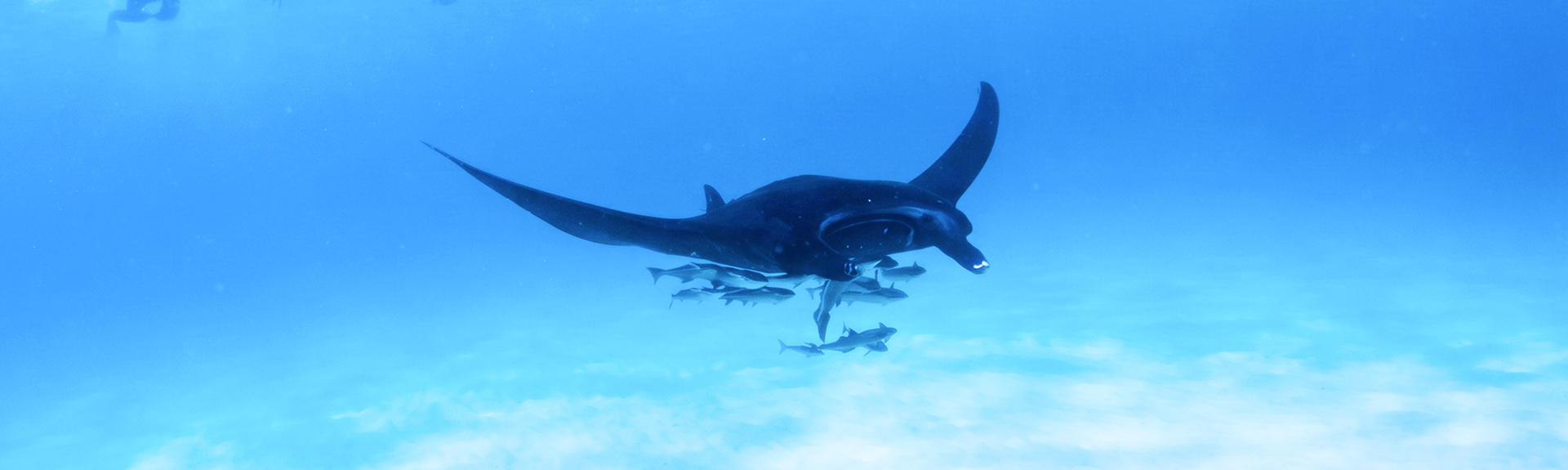
Short answer: No. Manta rays aren’t dangerous to humans. They have no venomous sting, no teeth that can break skin and no interest in anything bigger than a shrimp. Still, when an animal with a wingspan wider than a car glides past you in the water, it’s natural to wonder what you’ve signed up for.

Whether you’re snorkelling at Ningaloo Reef in Western Australia, diving at Lady Elliot Island on the Great Barrier Reef or hoping to spot one in New Zealand’s Bay of Islands, here’s what you need to know: what manta rays are, why they’re harmless, what can actually go wrong on an encounter and where to see them in Australia and New Zealand.
Are manta rays dangerous to humans? The quick answer
No. Manta rays are filter feeders that strain tiny plankton from the water, so people aren’t on the menu. They don’t have a venomous barb, and their teeth are far too small to hurt you. The only realistic physical risks are accidental contact (a very large animal bumping into a swimmer who’s in its way) and the boat traffic around popular manta sites.
In practice, manta rays are far more likely to be harmed by people than the other way around.
Which manta rays live in Australia and New Zealand?
There are two species of manta ray, and both turn up in our part of the world.
| Reef Manta Ray | Giant Manta Ray | |
|---|---|---|
| Scientific name | Mobula alfredi | Mobula birostris |
| Size | Up to about 5.5 m across | Up to around 8 m (26 ft) across |
| Where in Australia and NZ | Australia: Ningaloo Reef, the southern Great Barrier Reef, North Stradbroke Island and Byron Bay | Australia and New Zealand (north-east North Island) |
| Habits | Coastal, returns to reef “cleaning stations” | More migratory, found in open water |
| Conservation status | Vulnerable globally, Least Concern in Australia (as per IUCN and Fishes of Australia) | Endangered globally and in Australia (as per IUCN and Fishes of Australia) |
Both species are the largest rays in the ocean, and both are slow breeders. A female typically gives birth to a single pup every two to three years, and the pup is independent from the moment it’s born. Mantas can live for around 50 years, which makes every loss to the population count.
Why manta rays can’t hurt you
They don’t have a stinger
People worry about mantas because they look like stingrays, and stingrays do have a venomous barb on the tail. Mantas don’t carry one. Giant mantas do have a small thorn at the base of the tail, but it’s mostly encased in a hard, calcified lump and isn’t a stinging barb like a stingray’s.
Their teeth are tiny
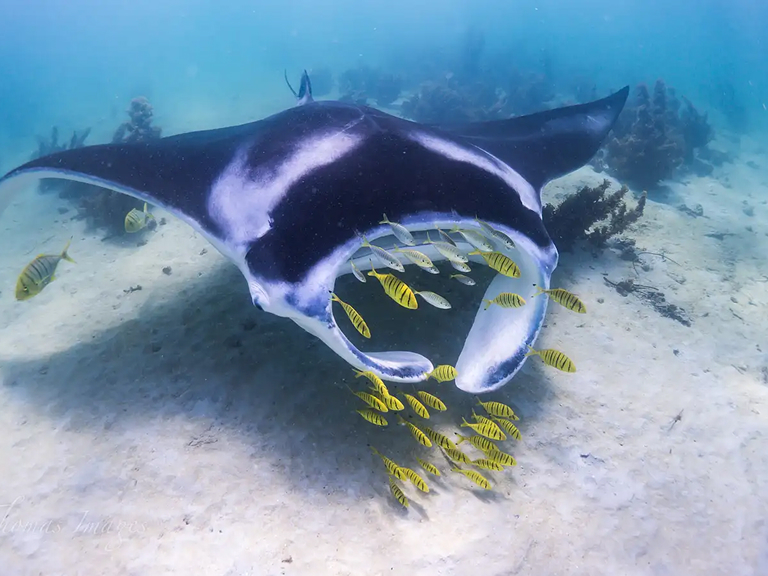
A manta ray has hundreds of very small teeth, but they’re used for feeding, not defence. They can’t break human skin. If a manta feels threatened by a swimmer, it simply swims away.
They eat plankton
Mantas swim with their mouths open, using the horn-like fins on either side of their heads (the reason they were nicknamed “devilfish”) to funnel water and food in. Their diet is zooplankton and other tiny organisms such as krill. There’s nothing predatory about them.
Manta ray vs stingray: A quick guide
- Mouth: a manta’s mouth sits at the front of its head. A stingray’s is on its underside.
- Where you’ll see it: mantas cruise through open water. Stingrays usually rest on the sandy bottom.
- Tail: a stingray has a long tail with a visible barb. A manta’s tail is slender and harmless.
- Size: mantas are much bigger. Stingrays are generally smaller and shaped like a diamond.
What can actually go wrong on a manta ray swim?
Mantas themselves are gentle, but a few things are worth knowing before you get in the water.
- Accidental contact. A wingbeat from a manta several metres across can knock a swimmer off balance. It usually happens when people crowd the animal or block its path, not because the manta is being aggressive.
- Boats and crowds. Around any wildlife hotspot, vessels and busy sites are usually the bigger hazard, for people and for the rays. That’s a good reason to book with a licensed operator who runs small groups and gives a proper safety briefing.
- Conditions and your own swimming ability. Operators expect you to be comfortable in deep water, and sea conditions and visibility change from day to day. Wild animals also run on their own schedule, so no reputable operator can guarantee a sighting.
How to swim with manta rays safely (and respectfully)
The rules are simple, and they protect the mantas as much as you.
- Listen to your guide. Rules vary by location, so follow the briefing over anything you’ve read online.
- Don’t touch. Mantas have a protective mucus layer that helps shield them from infection, and touching them can strip it away.
- Keep your distance. Staying at least three metres away is a common guideline, and some places ask for more.
- Never chase or block them. Mantas have to keep swimming and can’t swim backwards, so make sure you’re never in their path.
- Enter the water quietly. Avoid splashing and keep your fins below the surface.
- Float calmly and stay to the side. Let the manta decide how close it comes, and avoid approaching head-on.
- Divers, watch your bubbles. Stay low near the bottom and try not to exhale directly up into a manta passing overhead.
When you’re choosing a tour, look for small groups, experienced guides, a clear no-touch policy and a pre-swim briefing. Our guide to eco-friendly Coral Bay tours covers what to look for in a responsible operator.
Where to see manta rays in Australia
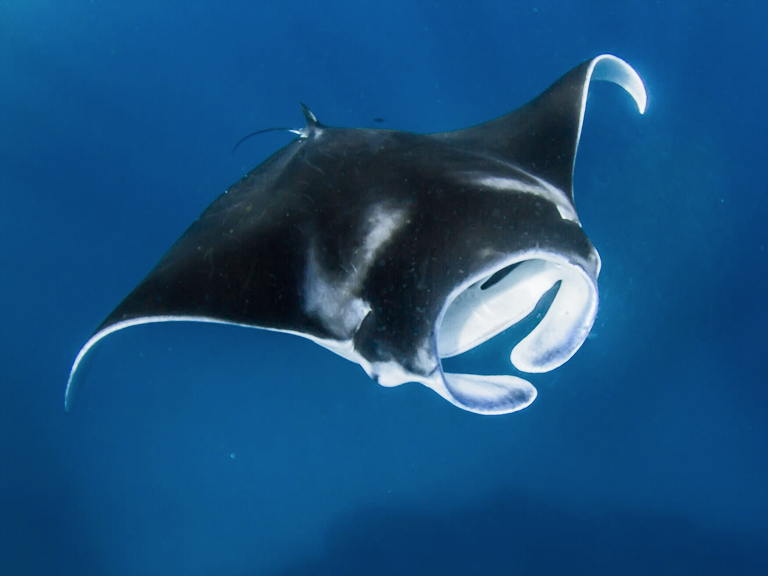
Ningaloo Reef and Coral Bay, Western Australia
Ningaloo is a World Heritage-listed reef that starts right at the shoreline, and reef mantas are found around Coral Bay through the year. The manta snorkelling season is roughly April to November (see our best month to visit Ningaloo Reef guide for the wider picture).
Ningaloo manta ray tour is a full-day trip of around seven and a half hours from Coral Bay, with two snorkels or two dives, a buffet lunch on board and a PADI guide leading the way. Wetsuits, masks, snorkels and fins are included. If you’d rather do a slightly shorter day out, the Marine Eco Safari with Manta Rays runs for six to seven hours with meals included.
As with any wildlife encounter, sightings can’t be guaranteed, so go with an open mind and enjoy the reef either way.
Lady Elliot Island, Queensland
Lady Elliot Island, at the southern end of the Great Barrier Reef, is nicknamed the “home of the manta ray”. Reef mantas are here all year, but numbers build in the cooler months, with the busiest period usually quoted as May to August. Researchers with Project Manta, which has studied the animals on Australia’s east coast since 2007, have found that individual mantas travel at least 500 km between Lady Elliot Island and Byron Bay. The island is reached by scenic flights from Bundaberg, Hervey Bay, Brisbane and the Gold Coast.
North Stradbroke Island, Queensland
Off “Straddie”, a rocky reef known as Manta Bommie is described by researchers and divers as the second most important manta gathering site in Australia after Lady Elliot Island. Mantas are mainly seen here from mid-spring to mid-autumn, gathering at cleaning stations on the reef.
Julian Rocks, Byron Bay, New South Wales
Julian Rocks (Nguthungulli) is a marine reserve just off Byron Bay where warm tropical and cooler temperate waters meet. It has a manta cleaning station, and mantas are most often seen in the warmer months. The Snorkel Tour of Julian Rocks Marine Reserve is a small-group, eco-certified trip with equipment and a free snorkel lesson in a heated pool included. You’ll swim with turtles and tropical fish, and with luck, a manta ray or two, but the rays are seasonal visitors and aren’t promised.
FAQs
Are manta rays poisonous?
No. Manta rays don’t produce venom and aren’t poisonous. Their stingray cousins are the ones with a venomous tail barb.
Do manta rays sting or bite?
No. They have no stinging barb to speak of, and their small teeth are only used for feeding.
Can manta rays hurt you?
Not on purpose. The main risk is being bumped if you’re in the animal’s path, which is why guides ask you to stay out of the way and keep your distance.
Can you touch a manta ray?
You shouldn’t. Touching can strip away the protective mucus layer that helps defend the animal against infection, and reputable operators enforce a strict no-touch rule.
How big do manta rays get?
Giant mantas can reach around 8 metres (26 feet) across, while reef mantas top out at about 5.5 metres.
Are manta rays endangered?
The giant manta ray is classed as Endangered and the reef manta ray as Vulnerable globally. In Australia, reef mantas are assessed as Least Concern, while giant mantas are Endangered.
Can you see manta rays in New Zealand?
Yes, but it’s a matter of luck. Giant mantas are seen mainly off the northeast North Island in summer, and there’s no guarantee of a sighting.